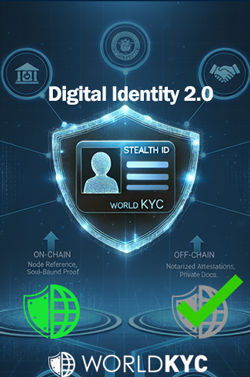
Digital Identity 2.0
A World KYC White Paper on the Economy of Trust
Executive Summary
Identity underlies every digital interaction, yet most systems remain either centralized and fragile or fragmented and inaccessible. Billions are unverified, unbanked, and excluded from the global economy.World KYC introduces Digital Identity 2.0 — a hybrid framework built on Notarized Sovereign Identity (NSID) and the Trust Signal Oracle, merging privacy, accountability, and sovereignty. Identity becomes a living trust fabric connecting individuals, businesses, and assets across borders.
Two real-world implementations demonstrate the model’s range:
- Sovereign Gold Reserve Token (SGRT) — a regulated, asset-backed monetary instrument issued by the AXIS Foundation on the XDC Network, integrating TradeEnabler infrastructure to embed the Trust Signal Oracle directly into on-chain finance and authenticated real-world assets.
- Sovereign ID Token (SID) — a reward and utility token on the TON Network, developed in collaboration with TON Stealth ID, which delivers decentralized authentication and secure communication for individuals and businesses within the World KYC ecosystem.
“The Sovereign ID Token (SID) — the currency of the Trust Economy.”
1. The Global Identity Challenge
- Centralized systems → efficient but expose citizens to surveillance and breaches.
- Self-sovereign systems → user-controlled but technically complex and siloed.
- Cross-border compliance → costly, inconsistent, and exclusionary.
-
4 billion people unbanked.
USD 4 trillion counterfeit losses annually.
Identity fraud is the fastest-growing form of cybercrime.
2. Evolution of Identity Systems
| Generation | Description | Limitations |
| Centralized ID | Government or corporate custodians (Real ID, SingPass). | Single point of failure; privacy loss. |
| Self-Sovereign ID (SSID) | User-controlled wallets for credential sharing. | Technically complex; limited adoption. |
| Notarized Sovereign ID (NSID) | Distributed Notary Nodes managing identity under sovereign law. | Balances privacy and sovereignty without central risk. |
3. Architecture of NSID
3.1. Notary Nodes
Operate under sovereign jurisdiction, managing attestations and compliance with legal accountability.3.2. Life Verification (Proof of Life™)
Authenticated members verify each other in person, confirming live presence without revealing private documents. Each verification enriches the verified party’s Trust Score, the network’s measure of confidence.3.3. Trust Signal and Trust Score
The Trust Signal shows authentication state (green = verified, yellow = unauthenticated, red = under review). The Trust Score reflects recency and frequency of verifications, rewarding continuous human validation.3.4. V-Link — Notarized Sovereign Identity Link
A V-Link extends verified identity to businesses, wallets, or products. Each inherits its issuer’s Trust Score, the sovereignty of its Notary Node, and the creator’s legal origin. V-Links authenticate brands, prevent counterfeit goods, enable verified reviews, and support private communications between authentic parties.3.5. Double-Pendulum Architecture
This architecture enhances both security and privacy. Each identity acts as an independent pendulum; if one credential is compromised, others remain secure. Contextual separation delivers privacy; structural isolation delivers resilience — the security core of Digital Identity 2.0.4. The Trust Signal Oracle and Chain Governance
The Trust Signal Oracle links verified identity with on-chain transactions. It is chain-agnostic and currently active on both XDC and TON.XDC Network — Institutional Trust Layer
On the XDC Network, the oracle governs compliance for the Sovereign Gold Reserve Token (SGRT). Transactions remain anonymous to the public yet traceable through sovereign oversight. The AXIS Foundation issues SGRT and supervises reserve authenticity and national compliance.
TradeEnabler, working with World KYC, has implemented this architecture to bring real-world assets on-chain under the Trust Signal Oracle. Its deployment showed that authenticated assets can be memorialized as dynamic NFTs linked to Notarized Sovereign Identities — a milestone documented in “Real-World Assets (RWA) Brought On-Chain with XDC for WinstantGold Transparency” (tradeenabler.com/news/te-asset-on-xdc-rwa).
The WinstantGold Foundation operates only within this SGRT framework, defining which Notary Nodes are authorized to validate SGRT wallets and participants; it does not hold assets and has no role in the Sovereign ID Token ecosystem. This deployment represents the first live instance of product-level notarized identity on the XDC blockchain — proving Digital Identity 2.0 in practice.
TON Network — Community and Identity Layer
On the TON Network, a separate Trust Signal Oracle governs the Sovereign ID Token (SID). This deployment, executed with TON Stealth ID, supports decentralized verification, peer-to-peer rewards, and business authentication within Telegram and TON applications. Together, the two chains demonstrate how Digital Identity 2.0 enables privacy-preserving accountability across distinct sovereign frameworks.
5. The Sovereign ID Token (SID)
SID is the utility and reward layer of Digital Identity 2.0, incentivizing verified humans and providing businesses with trusted authentication without centralized data storage.Individuals earn SID for: Life Verification (Proof of Life™), onboarding peers, and checking in with verified businesses.
Businesses spend SID to: authenticate users and wallets via V-Links, communicate with verified clients, and register products on-chain.
Each transaction funds oracle maintenance and governance, creating a self-sustaining trust economy.
“The Sovereign ID Token (SID) — the currency of the Trust Economy.”
6. The Sovereign Gold Reserve Token (SGRT)
SGRT, issued by the AXIS Foundation, is a sovereign monetary instrument on the XDC Network, backed by verifiable in-ground gold reserves. Each transaction uses the Trust Signal Oracle for lawful compliance while protecting privacy via zero-knowledge proofs.The WinstantGold Foundation defines which Notary Nodes may authenticate SGRT wallets and participants, ensuring standards without custody of assets.
The TradeEnabler RWA integration showcases this process in action, where each authenticated asset under WinstantGold is represented on-chain through NSID-linked attestations.
This implementation validates that Trust-Signal-based identity can govern both individual and asset authentication, uniting transparency and regulatory compliance.
7. Decentralized Custody and Treasury Core Integration
World KYC is integrated with Treasury Core (Canada), which uses WinstantPay’s decentralized digital-asset infrastructure to connect traditional finance with Web3 settlement. Treasury Core abstracts blockchain complexity while splitting custody among multiple entities, achieving decentralized custody of both identity and assets.Where Cash App centralized Bitcoin sales, Treasury Core applies the same inclusivity principle with decentralized custody anchored in Notarized Sovereign Identity. Within its closed-loop ecosystem, both SID and SGRT are distributed on a pre-sale basis, combining financial accessibility with compliance.
8. Tokenomics of SID
| Participant | Action | Token Flow |
| Individuals | Verify peers / perform Life Verification / check-ins | Earn SID |
| Businesses | Authenticate or issue V-Links / verify products | Spend SID |
| Notary Nodes | Validate identities / host oracles | Receive fees |
| Network Fund | Maintains governance and oracle security | Ecosystem share |
9. Comparative Landscape
| Aspect | World ID / World Coin | World KYC / NSID |
| Purpose | Proof of personhood only | Comprehensive identity framework integrating proof of personhood, business & product trust |
| Governance | Controlled by a U.S. company subject to U.S. law and sanctions | Multi-sovereign custodianship under national law |
| Custody | Centralized corporate control | Distributed Notary Nodes validated by sovereign foundations |
| Compromise Risk | Single biometric ID can be compromised or resold | Contextual IDs are revocable and isolated |
| Token Type | WLD (speculative) | SID (utility / reward) |
| Regulatory Context | U.S.-centric framework | Multi-sovereign architecture aligned with local law |
| Compatibility | Standalone unique ID | World ID can be embedded within NSID for added sovereignty and privacy |
10. Implementation and Roadmap
- TradeEnabler (XDC Network): implementation partner integrating the Trust Signal Oracle for the
Sovereign Gold Reserve Token (SGRT) and already live with real-world asset authentication on XDC, as documented in
“Real-World Assets (RWA) Brought On-Chain with XDC for WinstantGold Transparency.” This deployment memorializes notarized product identities as NFTs and demonstrates Digital Identity 2.0 applied to institutional-grade asset tokenization.
- TON Stealth ID (TON Network): integration partner deploying decentralized authentication and the Sovereign ID Token (SID) for human-verified messaging and community interaction.
- Treasury Core (Canada): closed-loop pre-sale platform providing decentralized custody and traditional payment integration.
- TON Chain: deployment of SID for peer verification and Telegram-based authentication.
- XDC Chain: operation of SGRT as a sovereign monetary instrument issued by AXIS Foundation and monitored by its Trust Signal Oracle.
- Expansion of V-Link and cross-chain oracle interoperability underway.
11. Conclusion
Digital Identity 2.0 is the missing layer of digital trust — a system where individuals, businesses, and assets authenticate each other without sacrificing privacy.Through the combined architecture of NSID, the Trust Signal Oracle, and sovereign governance by the AXIS and WinstantGold Foundations, World KYC bridges Web3 and traditional finance.
Real-world proof is already visible through TradeEnabler’s RWA deployment on XDC, where authenticated assets are tokenized and governed by sovereign identity logic, and through TON Stealth ID’s integration on TON, bringing verified human presence to decentralized communication.
It delivers a secure, sovereign, and compliant path toward a truly inclusive digital economy — the Economy of Trust.
Digital Identity 2.0 is not just about who you are — it’s how the world can trust who you are.
Digital Identity 2.0
The Economy of Trust
White Paper