TrustSignal Oracle
A Compliance and Policy Layer for Regulated Digital Assets on Public Blockchains
Abstract
As banks and other regulated financial institutions, as well as governments and enterprises, expand into tokenization and on-chain settlement, a core challenge remains unresolved: how to enforce compliance, jurisdictional policy, and identity accountability without centralizing asset custody or exposing sensitive identity data on public blockchains.TrustSignal Oracle addresses this challenge by introducing a decentralized compliance and policy layer that gives token issuers direct control over transaction rules. By defining these rules in collaboration with issuers, TrustSignal relieves them of the operational burden of whitelisting and ongoing compliance enforcement. It enables issuer-defined enforcement based on identity attestations and jurisdictional context, allowing risk-based and regulation-aware transaction controls without centralizing custody or exposing sensitive data.
TrustSignal allows smart contracts to determine whether a transaction may proceed, while preserving privacy through zero-knowledge proof (ZKP) authentication and regulated custody of identity.
TrustSignal is blockchain-agnostic and oracle-agnostic. It does not replace oracle transport networks that deliver external data to smart contracts. Instead, it complements them by providing the missing compliance and policy logic required for regulated activity on public blockchains.
1. The Compliance Gap in Decentralized Systems
Public blockchains provide transparency, composability, and decentralized asset custody. However, most token implementations today rely on static whitelists, centralized allow-lists, or post-transaction analytics. These approaches are insufficient for regulated use cases such as bank-issued digital instruments, securities, real-world assets, trade finance, and cross-border financial activity.Such mechanisms either centralize control, compromise privacy, or fail to meet regulatory expectations for continuous compliance. What is missing is a policy layer capable of translating real-world regulatory requirements into enforceable on-chain conditions.
2. TrustSignal Oracle: Purpose and Scope
TrustSignal is a compliance and policy oracle designed to operate alongside smart contracts. Its function is not to deliver raw external data, but to evaluate whether a transaction should be permitted, based on issuer-defined rules and identity-based attestations.TrustSignal enables:
- issuer-defined compliance and transfer rules,
- jurisdiction-specific enforcement,
- identity-aware risk evaluation,
- privacy-preserving verification using zero-knowledge proofs,
- continuous compliance monitoring over time.
3. Policy vs Transport: A Foundational Separation
A core architectural principle of TrustSignal is the separation of policy from transport.- Oracle transport layers deliver external data to smart contracts (events, attestations, reference data).
- TrustSignal applies compliance logic and policy rules to determine whether a transaction may proceed.
- Transport answers: “What is the data?”
- TrustSignal answers: “Should this transaction be allowed?”
4. Custody of Identity: Decentralized and Centralized Models
TrustSignal supports multiple custody models for identity, without imposing a single approach.Decentralized Identity Custody
Identity verification may be performed by regulated or sovereign Notary Nodes acting as identity custodians. These entities conduct KYC/KYB off-chain and retain custody of identity data. TrustSignal consumes zero-knowledge attestations that confirm compliance without revealing identity on-chain.
Centralized Identity Custody
Certain asset classes, such as securities issued by public companies, may require centralized custody of identity information under securities regulation. In these cases, TrustSignal enforces compliance using attestations from a single authorized identity custodian, while preserving the same policy and enforcement model.
TrustSignal therefore accommodates both decentralized and centralized identity custody, depending on regulatory requirements.
5. TrustSignal Risk Levels
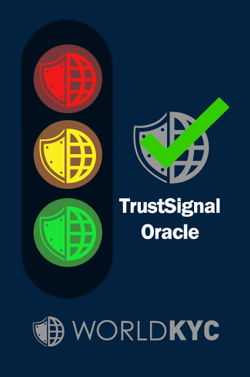
TrustSignal evaluates transactions using issuer-defined risk levels. A common reference model includes:- Green — authenticated and compliant; transaction permitted
- Yellow — unauthenticated or partially authenticated; transaction permitted only within issuer-defined thresholds
- Red — non-compliant; transaction blocked
6. Decentralized Whitelisting
Traditional whitelisting mechanisms are static and centralized. TrustSignal enables decentralized whitelisting, allowing issuers to accept compliance attestations from trusted identity custodians across jurisdictions.This model closely resembles correspondent banking, where institutions rely on trusted counterparties while retaining policy control, jurisdictional alignment, and risk governance.
Regulated institutions that are legally required to maintain custody of customer identity within their jurisdiction naturally qualify as Notary Nodes within the TrustSignal framework. This includes banks, telecom operators, and other regulated entities that already perform identity verification and ongoing compliance as part of their core operations. In this model, a bank may act as a Notary Node for its customers by issuing Stealth IDs and Notarized Sovereign IDs, allowing identity attestations to be used on-chain without exposing underlying personal data. This enables TrustSignal to integrate seamlessly with existing correspondent banking and cross-border compliance models, while preserving jurisdictional sovereignty over identity custody.
7. TrustSignal Registry Model
TrustSignal may include an on-chain registry that anchors trust relationships between wallet addresses and identity custodians.At minimum, the registry records:
- wallet address,
- identity custodian or Notary Node,
- jurisdiction,
- chain identifier,
- status (active or revoked).
- a wallet address may be bound to one identity custodian only,
- reassignment is not permitted,
- identity data remains off-chain,
- smart contracts can reference trust status in real time.
8. Oracle-Agnostic Architecture
TrustSignal is oracle-agnostic. It does not prescribe a specific oracle transport provider.The token issuer determines:
- which blockchain is used,
- which oracle transport layer delivers external data,
- which compliance rules are enforced through TrustSignal.
9. Reference Implementation: TradeEnabler on XDC
TradeEnabler provides a reference implementation of TrustSignal through the issuance of regulated tokens on the XDC Network. These tokens leverage decentralized asset custody, decentralized identity custody, and issuer-defined compliance rules enforced via the TrustSignal Oracle, operating in conjunction with the Plugin oracle transport layer for the delivery of external data to smart contracts.TradeEnabler is an XDC Network–incubated platform focused on regulated real-world assets, trade finance instruments, and institutional-grade financial workflows. This implementation demonstrates how TrustSignal can be deployed in production while remaining reusable across other platforms and blockchains.
10. Participation by Regulated Banks
TrustSignal enables regulated banks to participate in on-chain financial networks without altering their existing operating model. Institutions may issue deposit-style digital instruments while continuing to rely on their current compliance departments, SWIFT-based correspondent banking infrastructure, and internal deposit systems.Reconciliation of on-chain instruments can be reflected in the bank’s general ledger on a near real-time basis, in the same manner as traditional deposit platforms. Blockchain complexity is abstracted and managed by specialized infrastructure providers, allowing institutions of any size to participate without requiring in-house blockchain expertise.
11. Why TrustSignal Matters
TrustSignal provides the missing compliance and policy layer required for regulated participation in decentralized systems. By separating policy from transport and identity from asset custody, TrustSignal enables regulated institutions to operate on public blockchains while preserving privacy, sovereignty, and regulatory alignment.12. Conclusion
TrustSignal makes it possible to imagine a world in which regulated financial institutions around the globe can fully leverage blockchain technology without compromising their existing platforms, regulatory obligations, or operating models.In this model, banks and other regulated institutions can strengthen their treasury operations, expand and diversify their deposit base, and serve clients seamlessly on-chain or off-chain. Transactions can be executed in real time, across borders, with compliance enforced at the policy level rather than through fragmented post-hoc controls. Identity, jurisdiction, and risk are handled through trusted Notary Nodes, allowing institutions to focus on client needs instead of navigating siloed correspondent banking constraints.
Crucially, this evolution does not require abandoning existing financial infrastructure. Networks such as SWIFT remain integral as trusted communication and settlement layers, while TrustSignal augments these systems by enabling policy-driven, identity-aware enforcement and near-instant settlement between collaborating institutions. In parallel, TrustSignal produces compliance and transaction signals that can be expressed using ISO 20022-aligned reporting structures, allowing regulated institutions to maintain consistent regulatory reporting, auditability, and interoperability across both traditional and on-chain environments.
The result is a truly decentralized correspondent network—one that preserves regulatory sovereignty, enhances transparency, and accelerates settlement without centralizing control. By separating policy from transport and identity custody from asset custody, TrustSignal enables regulated institutions to participate in a globally connected financial system securely, compliantly, and at scale, while remaining firmly anchored in the systems, standards, and frameworks they already trust.
TrustSignal Oracle
The Economy of Trust
White Paper