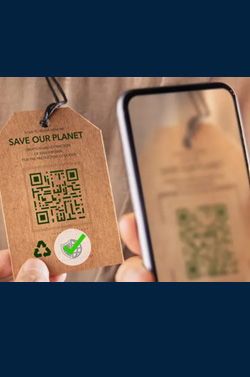
Protecting and Growing Brand Value
Win in a World of Fake Products, Fake People, Fake Reviews, and Fake Trust
1. Executive Summary
Brands today face a silent but accelerating erosion of value—not primarily from competition, but from counterfeit products, unauthenticated communication, automated reviews, and artificial identities.In the modern digital economy:
- Anyone can claim to review a product
- Anyone can impersonate a brand or a customer
- Bots and AI-generated content can simulate legitimacy at scale
- Counterfeit products cause real-world harm while damaging legitimate brands
- Content moderation
- Platform takedowns
- Legal enforcement
- Supply-chain audits
Brand value is no longer protected by marketing alone; it requires identity infrastructure.
This paper introduces Product Identity as foundational brand infrastructure—enabling brand protection, brand amplification, compliant communication, and regulatory-grade traceability, while preserving privacy and data sovereignty.
At the center of this framework is the Verified Link (V-Link): a cryptographically verifiable, bi-directional connection between a real product and a real human, without requiring disclosure of personal identity.
2. The Structural Problem: Brand Sabotage by Proxy
Brands are increasingly harmed indirectly.A counterfeit product fails.
A fake reviewer posts negative feedback.
A bot amplifies the message.
The brand absorbs the reputational damage.
This dynamic is best described as brand sabotage by proxy:
- The attacker is not visible
- The product is not authentic
- The reviewer is not verifiable
- The platform cannot distinguish truth from noise
- Proof of product authenticity
- Proof of purchase
- Proof of personhood
The result is a dangerous trust asymmetry:
- Illicit actors operate anonymously and at scale
- Legitimate brands are held accountable without context
3. Fake People, Real Damage: The Collapse of Review Trust
AI has fundamentally altered the review economy.Today:
- Bots generate reviews indistinguishable from humans
- Deepfakes simulate behavior, language, and sentiment
- Platforms rely on probabilistic detection, not proof
- Nobody has to prove they are real.
- This is no longer a platform issue. It is a structural identity failure.
Stealth ID introduces a zero-knowledge proof of personhood that confirms a reviewer is real, unique, and human—without revealing who they are.
The reviewer may remain anonymous, but anonymity is no longer equivalent to unaccountability.
In an AI-driven environment:
- Identity disclosure is dangerous
- Identity absence is exploitable
- Proof without exposure is the only sustainable model
4. Fake Products, Real Reviews: Binding Reviews to Reality
Equally damaging is the absence of product-bound reviews.In most systems:
- A reviewer does not need to prove they bought the product
- A review is not tied to a specific unit or batch
- Counterfeit experiences contaminate legitimate brand perception
Each product:
- Is issued and registered by the brand
- Has a unique, verifiable identity
- Can be authenticated via QR, NFC, or digital lookup
- Is cryptographically linked to that product
- Is submitted by a verified human
- Becomes tamper-resistant and traceable
5. The Bi-Directional Verified Link (V-Link)
A Verified Link (V-Link) is a cryptographically verified, bi-directional connection between:- A real product
- A real consumer
What This Enables
For brands:
- Direct, private communication with verified users
- Precision alerts (batch issues, recalls, safety notices)
- Regulatory engagement without mass exposure
- Product-specific communication without registration
- Anonymity with accountability
- Ongoing interaction tied to the exact product they use
6. Reviews as Brand Builders, Not Just Brand Defenders
Authenticated reviews do more than reduce harm. They actively build brand value.In luxury and high-value markets:
- Authenticity creates social capital
- Secondary ownership reinforces brand prestige
- Bragging rights are a real economic force
- Consumers confidently showcase authenticity
- Secondary markets amplify brand narrative
- Counterfeits lose social and economic value
7. Incentives Without Data Colonialism
Many incentive systems extract value by centralizing user data.- Google-based incentives centralize data in the United States
- WeChat-based incentives centralize data in China
When a country bans biometric token rewards, it means users don’t own their data — platforms do.
World KYC flips that. Users own their identity and choose where it’s stored.
A node-based architecture enables:
- User-selected data custodians
- Jurisdictional data residency
- Medical, institutional, or sovereign custody
8. Regulatory-Grade Traceability — Two Distinct Domains
8.1 Digital Payments (Without Consumer Surveillance)In digital payments, the regulatory focus is merchant accountability, not consumer exposure.
This enables:
- Business-identified wallets
- Merchant-level transparency
- Auditability comparable to bank rails
8.2 Products, Returns, and Targeted Recall
For products, the focus is safety, quality, and accountability over time.
With Product Identity and V-Links, brands can:
- Trace products at unit or batch level
- Identify defective production runs
- Issue targeted recalls or alerts
9. Eligibility, Qualification, and Product Sellability
Eligibility in modern commerce is multi-dimensional:- Age
- Jurisdiction
- Qualification
- Legal right to be marketed to
9.1 Age-Based Eligibility
Cryptographic proof of minimum age thresholds:
- Over 16 — banking access, regulated wallets
- Over 18 — adult products and services
- Over 21 — alcohol, clubs, gaming (jurisdiction-dependent)
9.2 Professional and Institutional Qualifications
Verifiable attributes include:
- Accredited investor status
- Professional licenses
- Academic diplomas
- Institutional certifications
- Other attestations or recognitions
10. Case Study: Veritas Vine — From Grape to Grave
Veritas Vine demonstrates Product Identity across physical goods and digital assets.Beyond bottle authentication, it introduces the GRAPE token, representing value linked to wine production and provenance.
The GRAPE token:
- Enforces age-based eligibility
- Enforces jurisdictional restrictions
- Applies compliance before issuance or purchase
Annex A — Marketing Compliance
Protecting Brand Value Through Compliant CommunicationA.1 Marketing Compliance as Brand Protection
Marketing to an illegal or ineligible audience does not only create regulatory risk—it destroys brand trust.
A single unlawful solicitation can permanently damage credibility. Marketing compliance is therefore core brand infrastructure, not a legal afterthought.
A.2 The Structural Failure of Digital Marketing
Most digital marketing systems rely on inference:
- Age is guessed
- Jurisdiction is approximated
- Qualification is assumed
A.3 Verified Links (V-Links) for Compliant Communication
A Verified Link (V-Link) is a compliance-native communication channel. Eligibility is validated before delivery, shifting compliance from reactive enforcement to preventive assurance.
A.4 Eligibility-Based Marketing Enforcement
Marketing can be restricted by:
- Age
- Jurisdiction
- Qualification
- Product-specific legal rules
A.5 Legal Solicitation Without Surveillance
Many regulations govern who may be contacted, not the product itself.
Verified Links enable:
- Jurisdiction-aware solicitation
- Age-compliant outreach
- Qualification-restricted messaging
A.6 Jurisdiction-Aware Brand Communication
Brands may:
- Exclude entire countries or regions
- Accept or reject specific notary nodes
- Dynamically adapt eligibility rules
A.7 Monetization and Notary Node Incentives
Notary nodes may:
- Validate eligibility prior to communication
- Certify compliance attributes
- Provide audit attestations
A.8 Summary
Marketing that reaches the wrong audience is not just illegal—it is destructive.
Verified Links enable brands to:
- Communicate only with eligible recipients
- Respect age, jurisdiction, and qualification rules
- Prove compliance without invading privacy
11. Conclusion
Brands have invested heavily in design, marketing, and storytelling—only to see those efforts undermined by counterfeit goods, unauthenticated communication, and increasingly sophisticated abuse of digital systems.Artificial intelligence is no longer just automating content — it is producing artificial identity. Synthetic personas can now review products, impersonate customers, simulate ownership, and influence brand perception at scale. In this environment, trust can no longer be inferred. It must be cryptographically proven, product-bound, and human-anchored.
This shift fundamentally changes the nature of brand risk. What was once a problem of moderation and enforcement is now a problem of identity integrity. Without verifiable links between real products and real humans, brands are exposed to manipulation that is scalable, automated, and increasingly indistinguishable from legitimate behavior.
Product Identity addresses this challenge at its root. By anchoring trust in authenticated products, proof of personhood, and verified communication channels, brands regain control over their narrative, their customer relationships, and their long-term value.
The next era of brand value will not be built on logos alone. It will be built on:
- Verifiable products
- Real humans
- Trusted, compliant communication
- Privacy with accountability
Product Identity is no longer optional.
It is the foundation of trust in a world where artificial identity has become a systemic risk.
Related Frameworks and Case Studies
Product Identity builds on and connects to a broader set of frameworks and real-world implementations:- Digital Identity 2.0
Establishes proof of personhood, anonymity with accountability, and the architectural foundation for Stealth ID.
https://www.worldkyc.com/en/wp-25 - TrustSignal Oracle
Provides the rule-enforcement and signaling layer for eligibility, compliance, jurisdiction-aware decisioning, and verified communication across products, payments, and marketing.
https://www.worldkyc.com/en/trustsignal-oracle-paper - Veritas Vine
A real-world implementation of Product Identity in the wine industry, demonstrating authentication from origin through consumption, including jurisdiction-aware tokenization and compliant ownership.
https://veritasvine.com/
Protecting and Growing Brand Value